The Uncertainty of Cannabis Patents
This article reviews Patenting Pot: The Hazy Uncertainty Surrounding Cannabis Patents authored by Andrew Kingsbury published in the Cornell Law Review (2021).
If Charles Darwin had applied for a patent on natural selection, it might have looked a lot like today’s Cannabis IP filings — an attempt to fence in a force of nature. What happens when you try to patent a plant that refuses to stay in its lane? The Cannabis patent landscape is one of great of ambition, watered by regulation and overgrown with confusion.
The Great Patent Gold Rush—Now with Chlorophyll
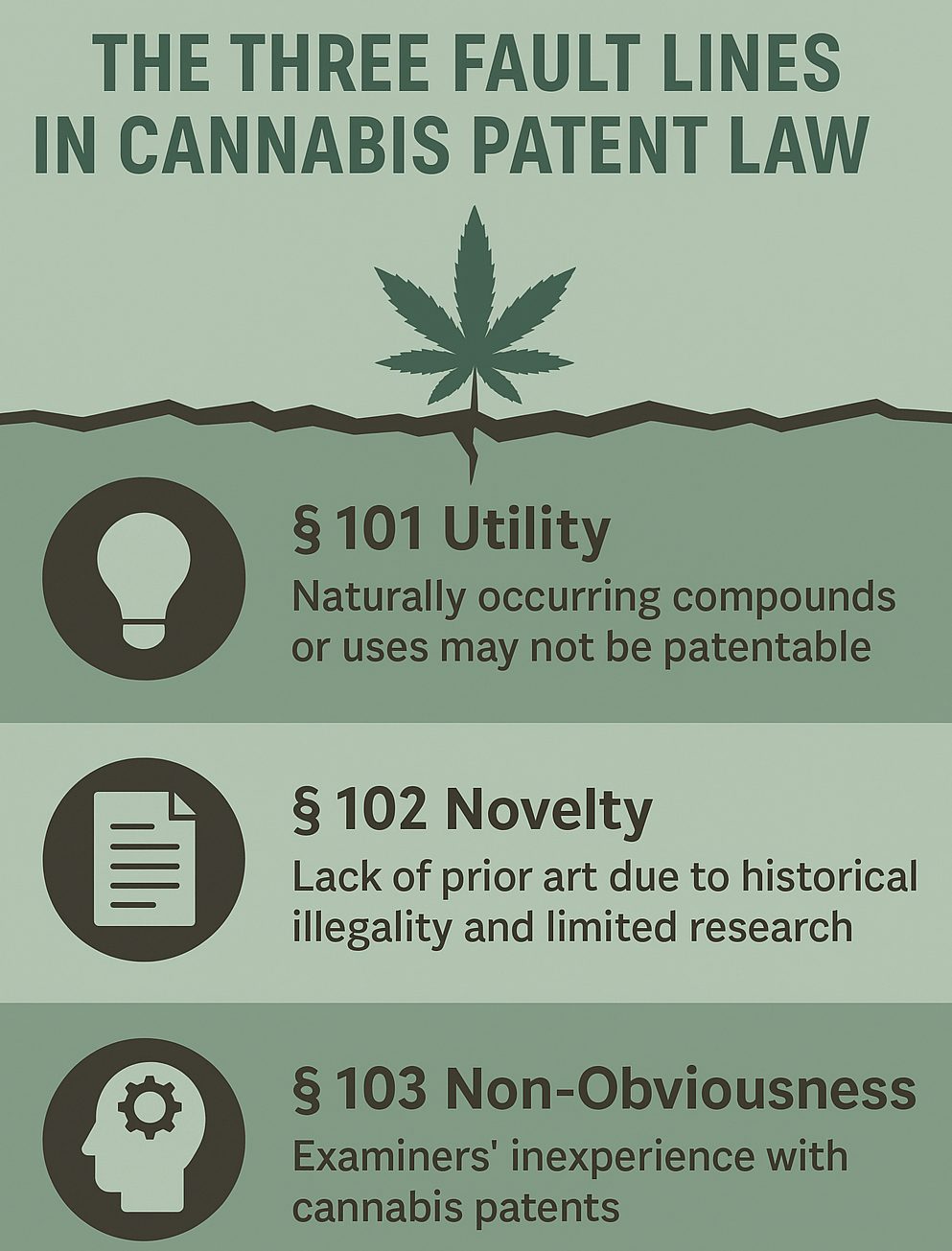
There’s a certain poetry in the spectacle: lawyers and lobbyists drafting the future of Cannabis one ambiguous claim at a time, while the plant itself continues doing what it has for millennia; adapting, hybridizing, and defying definition. In a market obsessed with innovation, the true novelty may lie not in the next cultivar, but in whether the law can evolve faster than the science it seeks to protect.
A Legal Maze in Full Bloom
In “Patenting Pot: The Hazy Uncertainty Surrounding Cannabis Patents,” Kingsbury offers a meticulous legal analysis of how Cannabis has slipped between the cracks of U.S. patent law. As the number of Cannabis patents has surged, so have concerns over subject-matter eligibility (§101), novelty (§102), and non-obviousness (§103). There are over 10,000 patents that have been filed but many of these filings might be too broad, under-supported by data, and vulnerable to challenge—a recipe for litigation disguised as innovation.
Ghosts in the Greenhouse: The Missing Prior Art
Kingsbury shows how the absence of prior art, a direct legacy of Cannabis prohibition, has allowed questionable patents to thrive. He likens this to the genomics patent bubble, where companies tried to claim ownership of what nature already wrote into the code of life. Here, the problem isn’t novelty; it’s documentation. You can’t cite research that was never legally allowed to exist.
The Author Speaks
“The race to patent cannabis mirrors the push for receiving patent protection for gene sequences because cannabis companies are similarly focused on bolstering patent portfolios to stave off competition as opposed to patenting innovative inventions. This cart-before-the-horse approach does not comport with patent law’s goals”.
“Broad patent protection for cannabis strains and products likely creates negative long-term effects for the industry by generating a ripe market for patent litigation.”
Prophetic words, already echoed in today’s transcripts related to hemp seed failures, market and regulatory uncertainty, and the theatre of prior art debates in the courtroom.
Why It Matters: Patents Without Proof
For inventors, it’s a warning shot—file in haste, litigate in leisure. For regulators, it reveals how federal inconsistency turns Cannabis IP into a legal paradox. For consumers, the cost of every vague claim trickles down in higher prices and slower innovation.
As an expert witness, I’ve seen how patent ambiguity collides with scientific uncertainty. Courts now debate whether a cannabinoid blend or genetic variant is “new” when its relatives have been cultivated for centuries. Here, evidence isn’t just legal—it’s chemical. Rigorous analytical methods, chain-of-custody, and reproducibility often determine whether a patent survives scrutiny.
The Data Gap Is the Policy Gap
This pattern mirrors other arenas I’ve written about—from impairment testing to FDA regulation. Where the data stop, speculation begins. And where speculation begins, litigation soon follows. Patent law, like drug policy, lives or dies on the integrity of its evidence base.
The Cannabis patent frontier is less about plants than about principles. As legality catches up to science, the question becomes: who will define “innovation”—the inventors, the regulators, or the experts who can translate between them?
The future belongs to those who can navigate both the chemistry and the case law.
